

From Spreadsheets to One Live Deal: How Navtech Built AI for Syndicated Lending
How do a dozen lenders agree on one deal when each is looking at a different spreadsheet?
A syndicated loan brings together a borrower, a lead arranger that organizes the deal, an agent bank that administers it after closing, and anywhere from a handful to dozens of lenders. Every one of them needs the same facts at the same time: terms, commitments, allocations, documents, and notices.
Across the industry, those facts typically live in spreadsheets, email threads, and PDFs passed from hand to hand. Versions drift, allocations get reconciled by hand, and nobody can see the whole deal at once.
That’s the gap Loan Ecosystem set out to close. Loan Ecosystem is a fintech company focused on syndicated lending, and Loan Ecosystem Online (LEO) is the platform Navtech built for it. LEO is one secure workspace where arrangers, agents, lenders, and borrowers all work on the same live deal. AI reads the borrower’s documents and flags anything it isn’t sure of for human review, and every party sees exactly what it’s permitted to see.
The payoff? A syndication cycle that is about 65% faster from launch to close, zero spreadsheets needed to run the book, and real-time deal visibility for every authorized party.
Industry
BFSI
Region
USA
Billion-dollar deals run on spreadsheets and inboxes
In a typical syndication, commitments and allocations are tracked in spreadsheets. Each deal ends up with multiple versions of the tracker, every change means manual reconciliation, and every reconciliation is a chance for a costly error.
Deal status is guesswork. Who has committed, who is still in credit review, and what’s outstanding all get answered through phone calls and email chases.
There’s no shared view. Each party sees a different slice of the deal, so trust depends on whatever sits in the arranger’s inbox.
And the most sensitive data often moves the least securely. Borrower financials and lender positions circulate as email attachments, with no access control and no audit trail.
Loan Ecosystem set out to change that. Fixing it meant more than building a better tracker. It meant giving competing institutions one shared workspace while making sure each sees only what it should. That takes serious engineering around permissions, security, and auditability, and Loan Ecosystem chose Navtech to build it.
Highlights
Syndicated loan closings
AI extraction accuracy
Fewer manual reconciliations
Status check-ins required
To issue lender notices
Deep Dive: What does it take to run a syndicated loan on one secure platform?
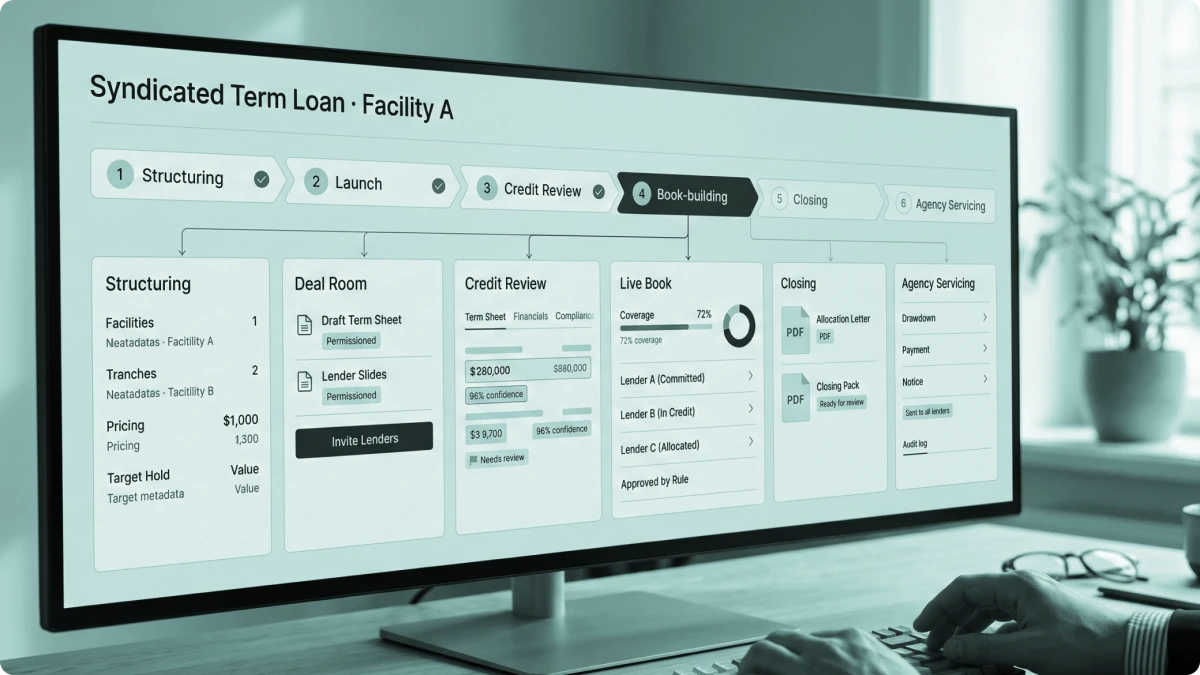
Navtech built LEO as a secure, multi-party workspace covering the whole syndication lifecycle. Every participant logs in to the same deal, sees exactly what they’re permitted to see, and acts on live data. There are no spreadsheets to reconcile and no versions to chase.
A deal moves through LEO in six stages:
- Structuring. The arranger sets the facilities, tranches, pricing, and target hold levels, meaning how much of the loan each lender is expected to keep.
- Launch. Lenders are invited into a secure deal room with permissioned documents.
- Credit review. AI reads the borrower’s documents, and risk analysis supports each lender’s review.
- Book-building. Lenders commit in real time, building up the “book” of who will fund how much, and allocations follow rule-based approvals.
- Closing. Allocation letters and closing packs are generated as PDFs and reviewed in the platform.
- Agency servicing. Drawdowns (when the borrower takes out funds), payments, and notices go out to every lender with a full audit trail.
AI sits at the center of credit review. Machine-learning-powered optical character recognition (OCR) classifies term sheets, financial statements, and compliance certificates, then extracts the key terms and figures. Every extraction carries a confidence score, so anything uncertain goes to a person for review. By the time a document lands in the deal room, AI has already read it, and a banker still makes the call.
Risk analysis builds on that data. LEO gives lenders borrower financial analysis, exposure and concentration views, and covenant tracking, which monitors the financial conditions the borrower has agreed to meet. Every lender makes its credit decision on the same verified numbers.
The live book replaces tracking spreadsheets. When a lender commits, the arranger sees it instantly, coverage updates in real time, and allocations are calculated against the arranger’s own rules.
Approvals follow each institution’s policy. Every bank sets its own approval parameters, including hold size, pricing, risk grade, and exceptions, and LEO routes each decision to the right authority automatically.
Paperwork happens in the platform too. Allocation letters, drawdown and rate notices, and closing packs are generated from templates, and parties can highlight, comment on, and mark up documents right in the browser.
Security was designed in from the start, because in syndicated lending, trust is the product. Access is set by role, party, and document, so each lender sees only its own position. Data is encrypted in transit and at rest on hardened AWS infrastructure. Notices, questions, and documents are exchanged inside the platform instead of over email, and every view, commitment, approval, and notice is logged.
Under the hood, LEO uses a layered architecture built for enterprise use:
- Java and Spring run the transactional core: deal management, the allocation engine, workflows, notices, and PDF generation.
- Python powers the machine learning layer for document classification, term extraction, and risk analytics.
- React delivers separate workspaces for arrangers and agents, plus a lender portal, a borrower portal, and an admin console.
- PostgreSQL and MySQL hold the data, and everything runs on AWS.
Generic tools move lending documents around. LEO reads them and leaves every credit decision with the lender.
Faster closes, fewer errors, total transparency
Live book-building takes the place of the email-and-spreadsheet cycle. Compared with a typical 6–8-week syndication, deals on LEO close in 2–3 weeks, a reduction of about 65%.
The manual work falls away with it:
- 90% fewer manual reconciliations of commitments and allocations
- 60% less agency admin effort on notices and reconciliations
- Allocation letters and notices reach the whole syndicate in minutes instead of days
- 75% fewer status calls and emails between the arranger and lenders
The AI performs reliably in production, extracting key terms and financials from deal documents with 96%+ accuracy. Anything below its confidence threshold still goes to a person.
The biggest change is transparency. For the first time, the arranger, the agent, and every lender look at the same deal at the same moment.
Loan Ecosystem has since been acquired.
LEO also shows what Navtech brings to banking. Navtech put machine learning into a live, multi-party lending platform before generative AI became the industry’s talking point. Navtech understands the full syndication lifecycle and the relationships between arranger, agent, lenders, and borrower. And it knows how to build a shared platform that competing institutions can trust. Today’s AI capabilities build on that foundation.