
Agentic AI Explained: A Practical Guide for Enterprise Decision-Makers
Key Insight
Agentic AI refers to AI systems capable of autonomous goal-directed behavior: planning multi-step tasks, using tools, making decisions, and taking actions in real-world environments without step-by-step human instruction. Enterprise agentic systems differ from chatbots by their ability to reason, act, and iterate across complex workflows.
- Most enterprise AI deployments to date have been reactive. A user types a query; the model responds. A document is uploaded; the model summarizes it. These are useful capabilities. They are not agentic AI.
- Agentic AI is different in a fundamental way: it acts. An agentic AI system does not wait for instructions on every step —it receives a goal, develops a plan, executes actions using available tools, monitors outcomes, and adapts its approach based on results. This shift from reactive to agentic AI is not incremental; it is architectural. The next three years will capture the most significant productivity and automation gains.
What Is Agentic AI?
- Agentic AI is an AI system architecture in which a language model (or ensemble of models) functions as a reasoning engine that can plan and execute multi-step tasks autonomously. The key characteristics that distinguish an agentic system from a conventional AI deployment are:
Goal-directedness — The system pursues an objective rather than responding to a single prompt.
Tool use —The agent can call external systems: APIs, databases, browsers, code executors, and communication platforms.
Planning and decomposition — The agent breaks complex goals into subtasks and executes them in sequence or in parallel.
Memory — The agent retains context across steps and sessions, building an understanding of ongoing work.
Iteration and self-correction — The agent monitors its own outputs, detects errors, and revises its approach without human intervention.
What Can Enterprise Agentic AI Systems Actually Do?
- The practical scope of enterprise agentic AI is broader than most decision-makers initially appreciate. Some examples from Navtech client deployments:
Procurement intelligence agents that monitor supplier news, regulatory filings, and market data; flag risk signals; and generate briefing notes for category managers — autonomously, on a daily schedule.
Contract lifecycle agents to ingest new contracts, extract key clauses, flag nonstandard terms, route to appropriate reviewers, and track negotiation status — replacing a workflow that previously required a team of paralegals.
Sales enablement agents that research prospect companies ahead of meetings, synthesize relevant news and financial signals, and generate personalized briefing documents — at scale, without SDR time.
Customer onboarding agents collect, validate, and process onboarding documentation, trigger system provisioning, and communicate status to customers — reducing onboarding time from days to hours.
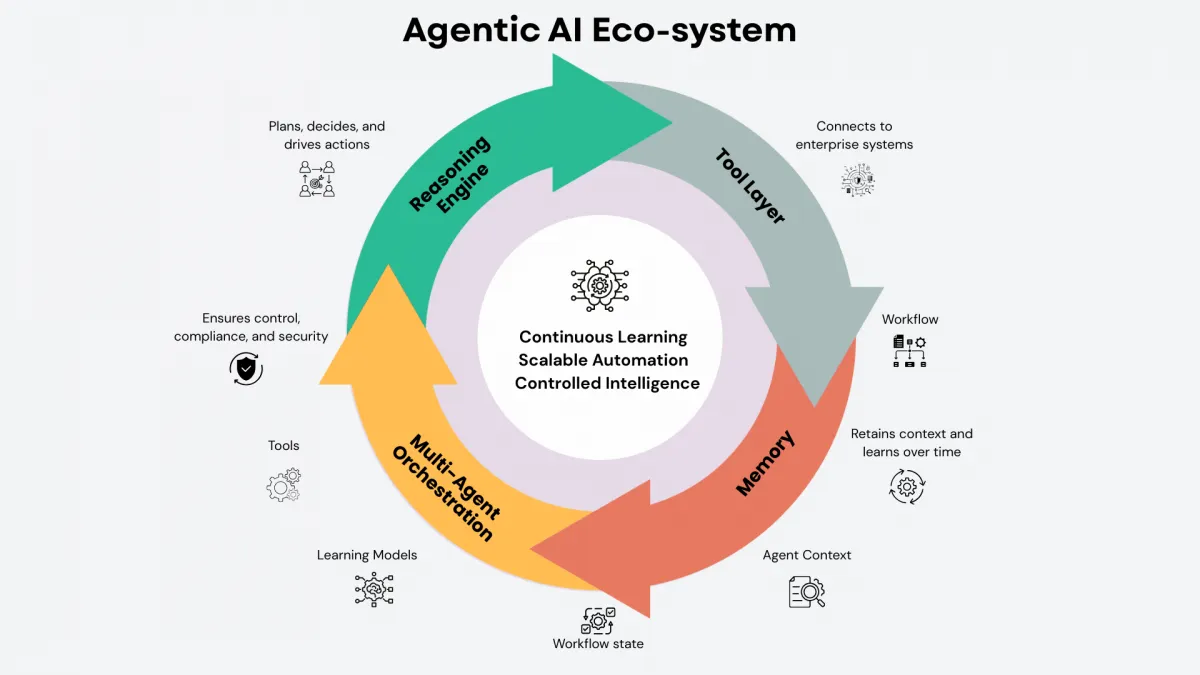
The Architecture of an Enterprise Agentic System
The Reasoning Engine
At the center of every agentic system is a language model that performs reasoning: understanding the goal, planning sub-tasks, interpreting tool outputs, and deciding next actions. In enterprise environments, this reasoning engine is typically a domain-specific or fine-tuned model — not a general-purpose LLM — to ensure the agent’s reasons correctly within the context of the business domain.
The Tool Layer
Agents are only as capable as the tools they can access. Navtech-built agentic systems are connected to the specific enterprise systems relevant to the use case: CRMs, ERPs, document management systems, financial databases, communication platforms, and custom internal APIs. Secure, governed API connectivity is a prerequisite for production agentic deployment.
The Memory Architecture
Enterprise agents require both short-term context (the current task’s working memory) and long-term memory (accumulated knowledge across sessions). Navtech implements vector database memory systems that allow agents to retrieve relevant historical context without exceeding model context windows.
The Governance Layer
Autonomous AI systems acting on enterprise data require guardrails. Navtech’s agentic deployments include action approval workflows for high-risk operations, audit logging of all agent decisions and actions, rate limiting and anomaly detection, and escalation paths for situations the agent cannot resolve confidently.
Single Agents vs. Multi-Agent Systems
While a single agentic system can handle many use cases, complex enterprise workflows often benefit from multi-agent architectures — systems in which multiple specialized agents collaborate, with an orchestrator agent coordinating the overall workflow.
A contract review system might deploy a document ingestion agent, a clause classification agent, a risk assessment agent, and a drafting agent in sequence, with each agent specialized for its function. This architecture produces higher quality outputs, more predictable behavior, and clearer governance than a single agent attempting to do everything.
Any Questions? We Got You.
Explore answers to common questions about Domain-Specific Language Models, implementation timelines, and cost considerations. Our FAQs help you quickly understand how DSLMs work and how they can benefit your business.
A chatbot responds to user queries in a single turn. Agentic AI systems pursue goals across multiple steps, using tools, making decisions, and taking actions autonomously. A chatbot tells you what to do; an agentic system does it.
Agentic AI can be deployed safely in enterprise environments with appropriate governance: role-based access controls on tool access, action approval workflows for high-stakes operations, comprehensive audit logging, human-in-the-loop escalation paths, and regular evaluation of agent behavior. Navtech builds these governance layers as a standard component of every agentic deployment.
Agentic systems can integrate with any system that exposes an API or structured data interface. Common enterprise integrations include Salesforce, SAP, Microsoft 365, Jira, Confluence, Slack, custom databases, and sector-specific platforms. Integration scope is determined during Navtech's discovery phase.
Focused single-agent deployments for well-defined workflows can be live in 6-10 weeks. Multi-agent enterprise systems typically require 3-5 months from discovery to production, depending on integration complexity and governance requirements.
Key Takeaways
- Agentic AI pursues goals autonomously across multi-step workflows — it is fundamentally different from chatbots or reactive AI.
- Key agentic characteristics are goal-directedness, tool use, planning, memory, and self-correction.
- Enterprise use cases span procurement, legal, sales, customer operations, and any workflow involving information synthesis and routine decisions.
- Enterprise agentic systems require a reasoning engine, tool layer, memory architecture, and governance layer.
- Multi-agent architectures produce higher quality and more governable outcomes for complex enterprise workflows.